
Most hybrid events fail long before the livestream
Why preparation, communication and clean workflows matter more today than the technology itself.
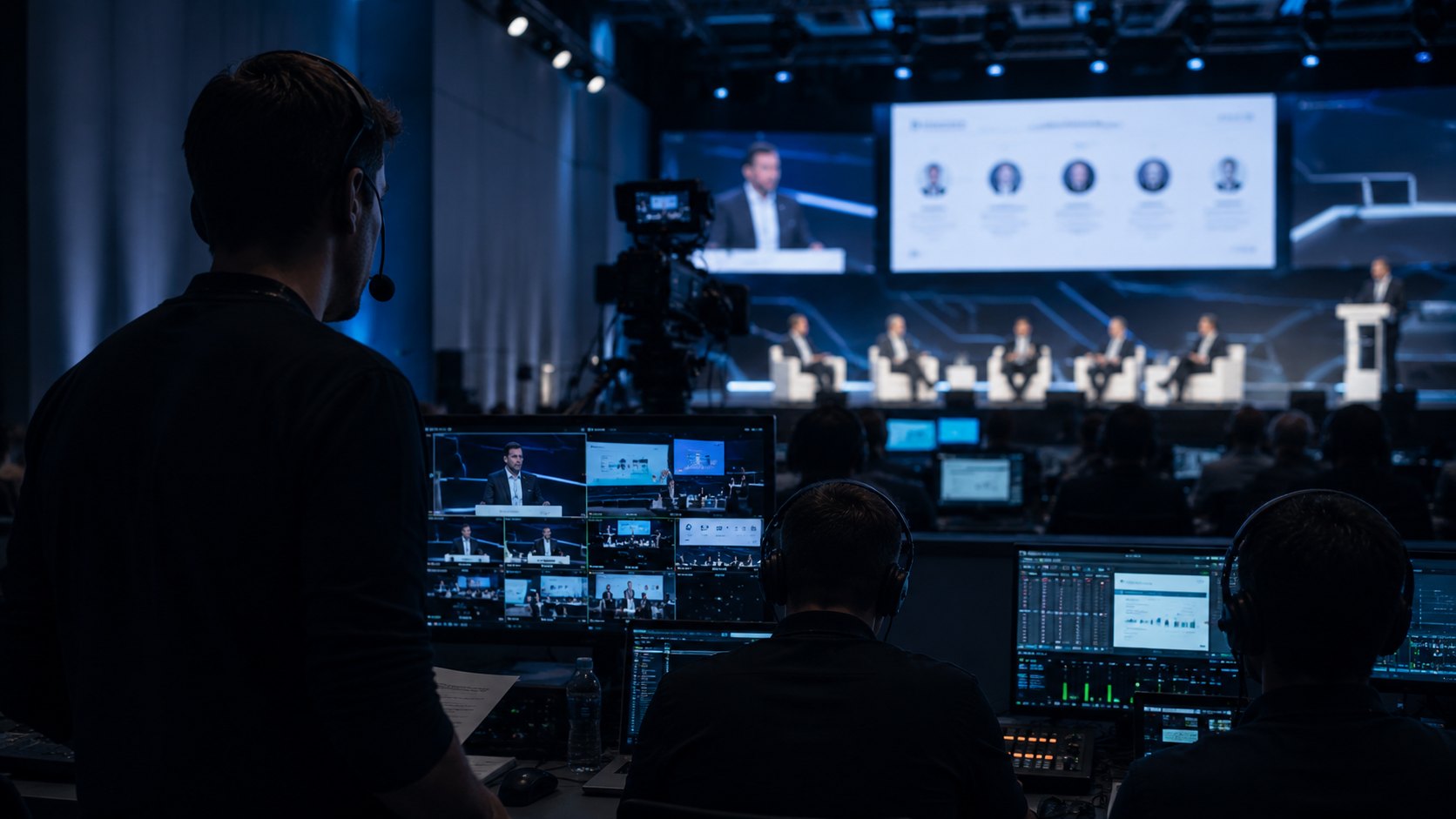
Hybrid often sounds simpler than it really is
From the outside, many hybrid events look relatively straightforward.
A stage.
A livestream.
A few cameras.
That is exactly why hybrid events are often underestimated.
Suddenly, one event has to work for two completely different situations: people in the room and participants joining digitally.
Both groups need to understand what is happening.
Both groups need to hear the speakers clearly.
Both groups need to see presentations cleanly.
And both groups notice immediately when something does not work.
Most problems do not start during the event
Most problems in hybrid events do not start live.
They often start days before.
When speakers have never had a technical test.
When presentations are only final shortly before the event starts.
When the actual technical setup is only clarified on site.
When audio and signal paths have not been tested properly.
When direction, technical team, organiser and moderation all have different information.
In hybrid production, preparation is often half the work.
Especially with congresses, international speakers or last minute changes, the quality is often decided less by the technology itself than by how quickly information moves between direction, technical team, organiser and speakers.
Why rehearsals suddenly matter again
Many hybrid events skip real test runs because time is short.
That often becomes expensive later.
When presentations are only tested live, it is usually already too late.
When speakers are technically connected for the first time once the stream is running, avoidable problems appear.
When signal paths have not been tested in advance, errors appear exactly when everyone is watching.
Short technical checks before the start often prevent more problems than adding more equipment.
Important checks include:
- presentation tests
- audio checks
- stream tests
- speaker handovers
- backup recording
- internet tests
- camera positions
- return feeds for remote speakers
Hybrid events often feel most professional when the technology remains almost invisible in the background.
Why audio is more important than the image
Many organisers talk about cameras first.
In practice, the quality of a hybrid event almost always starts with audio.
Participants are more likely to tolerate a simpler image than poor sound.
If audience questions are hard to understand or a speaker sounds hollow, the digital part of the event immediately loses quality.
This matters especially in:
- panel discussions
- expert talks
- congresses
- corporate events
- advisory boards
Audio often decides whether content feels professional or improvised.
Technology is changing fast
For a long time, hybrid production meant more cameras, more cables and more equipment.
AI supported production systems are now changing many workflows.
At broadcast trade shows such as NAB, it has become increasingly visible how much event and livestream productions are changing:
- AI supported speaker tracking
- intelligent auto framing
- automated camera moves
- live captions
- AI audio cleanup
- cloud based production systems
- remote direction
- automated highlight detection
The interesting point is that the technology is meant to become less visible.
The best hybrid productions are barely noticeable as technical productions. That is usually a good sign.
Why presentations are often underestimated
In many events, presentations are not just supporting material.
They contain charts, numbers, study data or central messages.
If this content appears blurred, incorrectly scaled or poorly integrated in the stream, the event immediately loses quality.
Professional hybrid productions therefore do not rely on filming projection screens. They use direct presentation feeds.
That may seem unspectacular.
But it is often the difference between:
"You can roughly see something"
and
"You can really follow the content".
Why hybrid events create long term content
The value of a hybrid event does not end with the livestream.
A single event can often create:
- expert statements
- highlight clips
- short recaps
- social media snippets
- interview sequences
- internal communication videos
- on demand content
- congress summaries
Well planned productions create content that can be used long after the event.
When relevant moments are considered early, the production automatically captures more usable material.
Why direction matters more than equipment lists
Technology alone does not produce a good event.
A strong event needs direction.
Who is on screen when?
When do we cut to the presentation?
How do audience questions enter the stream?
Who detects technical problems early?
Who communicates with speakers?
Who coordinates last minute changes?
Hybrid events only feel professional when workflows are clearly organised in the background.
The audience should notice as little as possible of how complex the production really is.
Conclusion
Hybrid events do not work because a camera is placed somewhere in the room.
They work when planning, communication, direction, audio and technology interact cleanly.
The actual quality often emerges long before the event begins.
That is why preparation, short communication paths and thoughtful production workflows are becoming more important for hybrid events.
FAQ
What is a hybrid event?
A hybrid event combines an on site event with digital participation. This includes congresses, corporate events, expert talks, panel discussions and medical symposia.
Why are pre event tests important for hybrid events?
Many problems only become visible during the live event. Presentation, audio and stream tests before the start often prevent critical errors.
What technology does a hybrid event need?
The most important elements are clear audio, stable streaming infrastructure, clean presentation feeds, reliable recording and clear direction communication.
What role does AI now play in event productions?
Modern production systems increasingly use AI for speaker tracking, auto framing, captioning, audio optimisation and automated production workflows.